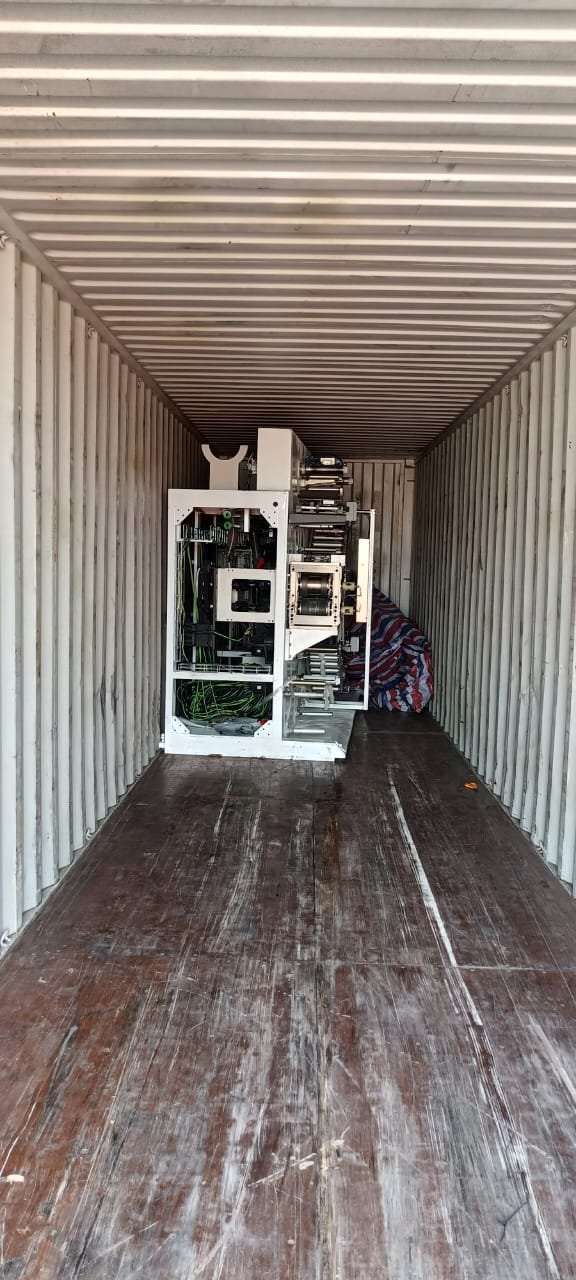
Real Work
Installation in Progress
Real photos and videos from an actual sanitary napkin machine installation — not stock images.
Also called shaft-based, chain-type or purely mechanical machines — these are the simplest, most affordable way to start sanitary napkin production. We install and commission them anywhere in India.
Real photos and videos from an actual sanitary napkin machine installation — not stock images.
A shaft-type (also called shaft-based, chain-type or purely mechanical) sanitary napkin machine uses a central shaft, gears, cams and chains to drive every station — core-forming, wrapping, cutting and sealing — in mechanical sync. There's no servo motor or PLC panel; motion timing is fixed by the physical linkage rather than being digitally programmable. This is typically the entry-level machine category in the market and is often simply listed as a "mechanical machine" by sellers.
Mechanical alignment is the single most important factor when installing a shaft-type machine — correct shaft alignment and chain tensioning determine how well the stations stay in sync during production. The machine needs a level, vibration-resistant floor, since mechanical vibration compounds over time and affects both output quality and part life. Power requirements are typically simpler than servo machines, often single-phase for smaller units, which makes shaft-type machines easier to set up in spaces with more basic electrical infrastructure. Once installed, these machines are generally easier for a local technician to service going forward, since there's no PLC or servo electronics involved.
It refers to a machine driven by a central shaft, gears, cams and chains rather than servo motors — motion timing at each station is fixed by the mechanical linkage instead of a programmable controller.
Yes, "shaft-type", "chain-type" and "mechanical" are generally used interchangeably in the market to describe a non-servo machine driven by mechanical linkage rather than servo motors.
Not necessarily less reliable — mechanical machines are often easier to repair locally since they use standard mechanical parts rather than electronics. They do offer less precision and speed flexibility than servo machines.
In some cases specific stations can be retrofitted with servo motors, but this depends heavily on the machine's original design. We can assess feasibility once we know the make and model.
Regular checks on chain tension, bearing wear, cam timing and lubrication are the main ongoing maintenance items. These are generally straightforward for a local mechanic familiar with mechanical equipment.
Installation is generally simpler since there's no servo calibration or PLC programming involved — mainly mechanical alignment, chain tensioning and a basic power connection, often single-phase for smaller units.
Tell us your location and machine details on WhatsApp — we'll guide you through the next steps.
Chat on WhatsApp